
 xrguo@xinhaimining.net
 +8618733132385
 +8618733132385



Overview of Hard Rock Lithium Ore Beneficiation Processes
2025-12-17 Xinhai (609)

2025-12-17 Xinhai (609)
If you have any questions, please contact us through the following ways, we will give you more and better assistance!

Lithium, a critical metal in the new energy era, relies on advanced beneficiation processes for efficient extraction. The beneficiation of hard rock lithium ores—mainly composed of minerals such as spodumene, lepidolite, and petalite—often requires "tailored" process flows based on ore characteristics. In current industrial applications, the following core beneficiation processes are primarily employed:
Used as a pre-concentration or supplementary method, this process relies on manual identification of differences in mineral appearance and color. It is suitable for coarse-grained, easily distinguishable spodumene ores or ores with distinct gangue characteristics. It allows for the preliminary picking of concentrate or rejection of waste rock, effectively reducing the load and costs of subsequent processing. However, it has a low degree of automation and imposes higher demands on the working environment and operator experience.
This process separates minerals based on differences in density, with the dense medium cyclone serving as the core equipment. By adjusting the density of the suspension, it enables the early recovery of concentrate and significant rejection of tailings at a coarse particle size. It offers advantages such as simple flowsheets, low costs, and good environmental performance, making it particularly suitable for the pre-concentration of spodumene and petalite.
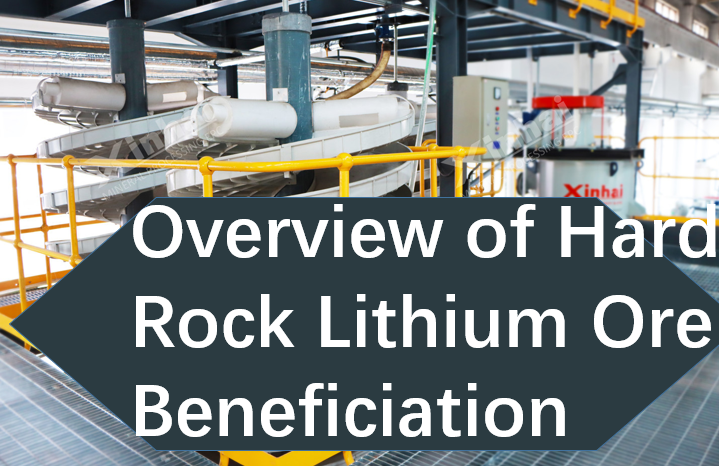
This is the most widely used method for processing finely disseminated lithium ores. For spodumene, two main processes are employed: direct flotation (using anionic collectors in alkaline media to directly float spodumene) and reverse flotation (depressing spodumene while floating gangue minerals). Lepidolite, due to its natural good floatability, is often recovered using fatty acid collectors under neutral conditions. The flotation process is highly flexible and can be optimized through reagent regimes to handle complex ores.
In lithium ore beneficiation, magnetic separation primarily plays an auxiliary role: firstly, to remove magnetic impurities from lithium concentrate, thereby improving product purity; secondly, to comprehensively recover associated weakly magnetic minerals (such as tantalum-niobium ores), enhancing resource utilization.
Facing refractory ores with complex mineral dissemination and diverse compositions, a single process often fails to achieve ideal outcomes. Modern concentrators frequently adopt combined flowsheets such as DMS pre-concentration followed by flotation concentration or magnetic-flotation combined processes. These are integrated with precise technologies for particle size control, density regulation, and reagent addition to achieve efficient lithium recovery and comprehensive utilization of associated resources, ultimately aiming to shorten the process, reduce costs, and enhance economic benefits.
Conclusion
The beneficiation of hard rock lithium ores is a systematic project characterized by multi-process synergy and high technological integration. From coarse-particle pre-concentration to fine-particle concentration, and from the recovery of the main lithium minerals to the comprehensive utilization of associated elements, the existing technological system can provide efficient and economical solutions tailored to the characteristics of different deposits. This offers critical technical support for the secure supply of lithium resources.


 Consult
 Message
 Email
Email