
 xrguo@xinhaimining.net
 +8618733132385
 +8618733132385



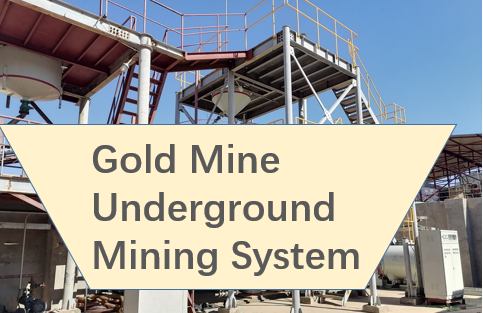
Gold Mine Underground Mining System
2026-11-13 Xinhai (9)

2026-11-13 Xinhai (9)
If you have any questions, please contact us through the following ways, we will give you more and better assistance!

An underground gold mining system is an integrated engineering framework composed of orebody development, mining method, ventilation, hoisting, haulage, ground control, drainage, power supply and safety monitoring. Unlike open-pit mining, underground gold projects face constraints from orebody geometry, rock mass strength, ground pressure and ventilation conditions. The whole system must be coordinated to guarantee safe, continuous and efficient gold ore extraction while controlling dilution and ore loss rate.
The development system is the first core component. It includes shafts, declines, crosscuts, drifts and ore passes that build access tunnels from surface to orebody. Shaft hoisting is suitable for deep and large-scale gold deposits, while decline development using trackless rubber-tyred equipment is more flexible for medium and shallow vein gold mines. Development layout should separate ore haulage, fresh air intake and exhaust return routes to avoid airflow pollution and transport interference. Ore passes are designed to transfer broken ore downward by gravity, reducing truck haulage distance and energy consumption.
Selection of mining method dominates system performance. Common methods for gold deposits include cut-and-fill stoping, sublevel stoping, shrinkage stoping and block caving. Cut-and-fill mining is widely used for narrow, steep gold veins and orebodies with weak surrounding rock. Cemented or rock fill is placed after ore extraction to support hanging wall and footwall, which effectively controls rock collapse and reduces ore dilution. Sublevel stoping suits thick, stable hard rock gold orebodies with regular shape. Shrinkage stoping applies to steep veins with competent rock, but its working environment and production flexibility are limited. Block caving delivers high capacity for large massive gold orebodies, yet it requires strict geomechanics assessment and cave management.
Auxiliary systems support normal operation of excavation and ore extraction. Underground ventilation systems deliver fresh air, dilute blasting fumes, remove dust and control heat in deep mines. Ventilation network design must prevent air short-circuit and gas accumulation. Haulage systems adopt LHD loaders, underground trucks or rail transport to move run-of-mine ore to ore passes or shaft bins. Ground monitoring, rock bolt and shotcrete support are arranged along drifts and stopes to cope with dynamic ground pressure, especially in deep gold mines with high rock burst risk. Drainage pumps collect groundwater to prevent flooding, while fire detection, refuge chambers and emergency communication form the safety guarantee subsystem.
Modern underground gold mining systems are evolving toward intelligence and automation. Autonomous drilling jumbos, remote LHDs, real-time mine dispatch platforms, underground positioning and communication networks are integrated into the control system. Drilling, charging, blasting, mucking and filling can be scheduled remotely to reduce personnel exposure in high-risk stope zones. Dilution and ore loss are two critical economic indicators for underground gold mines. Proper stope geometry, precise blasting design and timely filling are necessary to keep gold grade dilution within acceptable range. The whole mining system should be dynamically adjusted as mining advances, according to geological variation, rock condition and production target changes.


 Consult
 Message
 Email
